

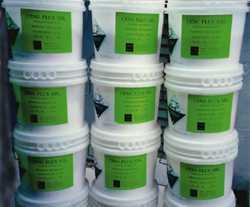
Aluminum Brazing Flux |


|
 |
| (CENO FLUX - NHL P251) |
 |
|
CERTIFICATE
OF ANALYSIS pH-value
: 5
Lithium chloride 7447
- 41 - 8
(Al Brazing Flux) Technical data: Active temperature: 520 - 640oC Melting range: 510 - 560oC Conditions as received: white powder Solubility in warer at 20oC: abt 150g/l pH value (10g/l) at 20oC: abt 6.5
Product Information Al brazing Flux (CENO FLUX NHL P251) Brazing fluxes Type SEKI are fluxes Type F - Li, with an active temperature of 520oC - 640oC This kind of fluxes is based on hygroscopical chlorides and fluorides.
CENO FLUX - NHL P251 is suitable for brazing processes at aluminium and aluminium alloys with Mg-content up to abt, 2.5% in weight. As brazing solder there can be used aluminium - silicon (AlSi) alloys with 7-13% in weight of silicon.
With regard to SEKI BRAZING process with our CENO FLUX - NHL P251 We are introducing you step by step as follows:
Preparation of initial bath suspension:
Flame brazing: 1. 25% in weight of water(preferably distilled water) as a basis 2. 75% in weight of CENO FLUX NHL P251 by degrees stirred with the water lumpy-free.
Furnace brazing: Steps 1. and 2. as above described.
3. Initial bath suspension stir for 5 hours and with water mix to a viscosity resp. draining time of approx. 7.5sec. (DIN-viscosity cup with 5 min nozzle).
After adding of water stir properly again till required viscosity is obtained.
Attn. : The final adjustment of viscosity should take place according to specific factors for use.
Attn. : During Preparation of hydrous suspensions there takes place an exotherm reaction which may heat up the preparation to nearly 100oC. Pre-cleaning Pre-cleaning is necessary to remove existing oil - and grease residues caused by hot rolling and pressing from the surfaces to the parts because those may possibly prevent a wetting with flux and this way make impossible flow of the brazing solder. Corroding and degreasing takes place in media, such as alkali solvents (e.g.NaOH) acid solvents (e.g.HNO3) or 1.1.1.trichlorethan resp. perchlorachylen.
Brazing process: Brazing process takes place in open - furnace atmosphere in ambient-air furnaces or in fore of flame - brazing. The choice of temperature is dependent on the plating base material.
Post cleaning: 1. Splash still warm radiators resp. heat exchangers (that is with object temperature of 300-400oC) after brazing process with cold water (quenching). This way the flux slag caused by different extensions of heat of Al-material gets loose (consequently physically) and bursts into little single particles. 2. After pre treatment accord. to 1. lift the radiators resp. heat exchangers up single or more. frequent put them into baskets, if possible in sloping position and then rinse sufficiently by frequent dipping into warm water (min, 60oC - max. 90oC). With Al-oil-coolers take care of rinsing sufficiently both the oil-and air resp, water face. 3. After this drain off the radiators resp. heat exchangers or possibly(if necessary) blow through with compressed air and once more treat with normal tap water as described above. 4. Following 1-3 the radiators resp. heat exchangers have to be dipped resp, flowed in nitric acid (approx, 5-10% HNO3 remainder water) with about 50-60oC bath temperature (dipping as described above). 5. Hereafter we recommend dipping and flowing of radiators resp. heat exchangers in cold normal tap water again. 6. The remaining water adhering to the radiators resp. heat exchangers should get evaporated in a suitable drying stove with a temperature if possible more than 130oC.
It stands to reason that described sequence of proceeding is variable, however measures and construction details have to be considered in any case, even special surface eflicts may be obtained by mixing to the nitric acid a small quantity of hydrofluoric acid (HF) (approx. 0.5 - 1.0% in weight).
Packing units : plastic boxes with 15 Kg |
 |
| ( CENO FLUX - NHL P - 251 ) |
 : 2.70%


|
|
||||||||||||||||||||||||
