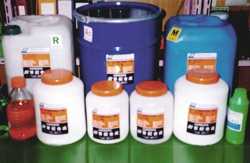
BONDERITE CK - 1208SA PROCESS
BONDERITE CK - 1208SA PROCESS
1. The BONDERITE CK - 1208SA(1202) Process
is designed primarily for treating steel
by spray application but mixed production of steel and zinc may also be processed
in
the same solution. It is designed to operate at low temperature, in the range
40oC to 50oC
The treatment converts the metallic
surface to a non - metallic zinc phosphate
coating adapted to inhibiting corrosion and increasing the adhesion and durability
of
paint finishes. This substantial increase in the life of the paint finish results
from the
fact that the coating provides: -
1. A clean, grease - free
surface.
2. A corrosion - inhibiting
base for paint.
3. A non - conducting bond between
the base metal and the paint.
2. MATERIALS
BONDERITE CK - 1208SA(1202)
COMPENSATING CHEMICAL 1 or COMPENSATING
CHEMICAL 2
Sod Ash or Caustic Soda
CENO CLEAN
CNT#NT2
COMPENSATING CHEMICAL 1 and
COMPENSATING CHEMICAL 2 are the
same in chemical composition, except that the latter is a concentrated solution
of the
former, COMPENSATING CHEMICAL 1 being a powder. COMPENSATING
CHEMICAL 2 may be used as received, but Compensating chemical 1 must be dissolved
in cold water (2 kg. per 10 litres) to give a 20% solution.
3. TESTING REAGENTS
Testing Solution No. 1 (0.1N
sodium hydroxide)
Indicator Solution No. 1 (phenolphthalein)
Indicator Solution No. 11(bromo
phenol blue)
Testing Solution No. 8 ( phosphoric/sulphuric
acid solution)
Testing Solution No. 6 (0.1N
potassium permanganate)
4. EQUIPMENT
Process tanks for all solutions
may be constructed of mild steel. However, if
stainless steel (Grade 316s) or rubber lined tanks are used for the BONDERITE
CK -
1208SA(1202) solution, longer tank life will result. pipe work and spray nozzles
should be
of stainless steel. Titanium and its alloy should not be used for heating coils
or any
other equipment coming into contact with the BONDERITE CK - 1208SA(1202) solution.
5. THE PROCESS
The complete process for
the application of BONDERITE CK - 1208SA(1202)
solution normally consists of the following steps : -
A. Cleaning.
B. Water rinsing.
C. Water rinsing.
D. BONDERIZING
E. Water rinsing.
F. Treatment.
G. Drying.
A. Cleaning
All metal to be BONDERIZED CK
- 1208SA(1202) should be free from grease,
oil, rust, loose scale or other foreign matter. The removal of grease and oil
is usually
carried out, by spray, in the first stage of the plant and CENO CLEAN 1106S
low
temperature alkaline cleaner, is used. If rust or loose scale has to be removed,
this is
usually done separately using an acid CENO CLEAN 1106S cleaner.
Instructions for the operation
and control of CENO CLEAN 1106S are given in
Technical Service Data Sheets 1106S respectively.
If rust or loose scale has
to be removed, SEKI Chemical Services Ltd.
Will recommend a suitable acid CENO CLEAN cleaner.
B. & C. Water rinsing
After cleaning, the metal must
be thoroughly rinsed with water. This is
normally done in the second stage of a five-stage BONDERIZING plant or in the
second
and third stages of a six-stage machine.
Carrying cleaner into the
BONDERITE CK - 1208SA(1202) solution will destroy
its chemical balance and will result in excessive use of BONDERITE CK -
1208SA(1202) chemical. The rinse (or rinses) should be overflowed at a rate
which will
keep it (or them) free from excessive contamination.
Detailed instructions for
the operation and control of water rinses are given in
Technical Service Data sheet.
D. BONDERITE CK - 1208SA(1202)
1. Make - up
Carry out the following operations
in the order given:-
(a) Determine the working volume of the tank and run clean water into it until
it is
about three - quarters full.
(b) Heat to 40oC to 5oC
(c) Add soda ash or caustic soda at the required rate and mix by operating the
pump(s)
for about 5 minutes. The soda
ash, or caustic soda, should be dissolved in water
at the rate of 5 kg. per 10
litres before being added.
(d) Add BONDERITE CK - 1208SA(1202) chemical at the required rate and mix by
operating the pump(s) for about
5 minutes.
(e) Make up to the operating level with clean water, heat to 40oC
to 50oC and mix by
operating the pump(s) for about
5 minutes.
(f) Add COMPENSATING CHEMICAL 1 at the rate of 0.25 kg., or COMPENSATING
CHEMICAL 2 at the rate of 0.8
kg. or 0.7 litre, per 1000litres of working
solution and mix by operating
the pump(s) for about 5 minutes.
COMPENSATING CHEMICAL 1 should
be dissolved in water at the rate of
2 kg. per 10 litres before being
added.
* The strength of the solution is denoted by the pointage (see "5.D.3
Testing and
Control" below) and the
pointage required depends on the temperature of the
working solution and the time
it is sprayed onto the work(process time) as
shown in the table below:-
TEMPERATURE
oC |
PROCESS
TIME |
MINIMUM
POINTAGE |
MAKE-UP
OF WORKING SOLUTION**
Soda ash or Caustic soda BONDERITE
CK - 1208SA(1202) |
30 to 40
40 to 50
30 to 40
40 to 50
30 to 40
40 to 50 |
60 secs.
" "
90 "
" "
120 "
" " |
25 Points
20 "
20 "
15 "
15 "
15 " |
1.9 Kg.
1.5 Kg.
1.5 Kg.
1.1 Kg.
1.1 Kg.
1.1 Kg. |
1.4 Kg.
1.1 Kg.
1.1 Kg.
0.8 Kg.
0.8 Kg.
0.8 Kg. |
50 Kg. 30.1 1.
40 Kg. 24.5 1.
40 Kg. 24.5 1.
30 Kg. 18.4 1.
30 Kg. 18.4 1.
30 Kg. 18.4 1. |
** Quantities per 1000 litres of working solution.
2. Operation
The process treatment consists
of spraying the properly cleaned work with
BONDERITE CK - 1208SA(1202) solution for a sufficient time to convert the metal
surface to a uniform coating. The time required is governed by the pointage
and
temperature of the solution and it is usual to adjust these two factors in accordance
with the time available in the particular plant as shown in the table above.
3. Testing and
Control
(a) Poitage
Take a 10ml. sample of the working
solution, add about 10 drops of Indicator
Solution No. 1 and titrate with Testing solution No. 1 until the colour of the
solution
changes from colourless to pink. The number of ml. of Testing solution No. 1
required
is known as the pointage of the solution.
The pointage should be maintained
within plus or winus ope of that required
according to the table above and BONDERITE CK - 1208SA(1202) chemical should
be
added at the rate of 1.8 kg. or 1.1 litres per 1000 litres of working solution
for each
point below that required. Frequent additions of small amounts of BONDERITE
CK -
1208SA(1202) chemical give more uniform results and it is best to add it continuously
at
the proper rate.
(b) Free Acid
Take a 10ml. sample of the working
solution, add about 10 drops of Indicator
Solution No. 11 and titrate with Testing solution No.1 until the colour of the
solution
changes from yellow to bluish-green by daylight or blue-violet by artificial
light. The
volume of Testing solution No. 1 required is a mea sure of the free acidity
of the
solution and this varies according to the temperature and pointage and is referred
to as
the free acid pointage.
The free acid pointage should
be maintained in the range shown in the table
below:-
TEMPERATURE
oC |
PROCESS
TIME Seconds |
MINIMUM
POINTAGE |
FREE
ACID POINTAGE |
30 to 40
40 to 50
30 to 40
40 to 50
30 to 40
40 to 50 |
60
60
90
90
120
120 |
25
20
20
15
15
15 |
0.75 to 0.95
0.55 to 0.75
0.4 to 0.6
0.4 to 0.6
0.4 to 0.6
0.4 to 0.6 |
The free acid pointage usually
remains within the specified range if the
temperature and pointage are maintained correctly. However, should it rise above
the
maximum required, soda ash should be added at the rate of 0.053kg., or caustic
soda at
the rate of 0.04kg., per 1000 litres of working solution for each 0.1 point
that it is too
high.
Free acid pointages below
the maximum required may be encountered if
excessive additions of COMPENSATING CHEMICAL 1, or COMPENSATING
CHEMICAL 2, have been made. In this case BONDERITE CK - 1208SA(1202) chemical
should be added at the rate of 0.2kg. or 0.8 litre per 1000 litres for each
0.1 point that it
is too low. This may increase the pointage above the normal operating strength
but this
will do no harm.
(c) COMPENSATING CHEMICAL 1 (or COMPENSATING CHEMICAL 2)
Before testing for COMPENSATING
CHEMICAL 1 (or COMPENSATING
CHEMICAL 2) dip a strip of starch-Iodide paper into the BODERITE CK-1208SA(1202)
solution. The paper should turn blue. should the paper remain colourless, acidify
the
portion wetted with the BONDERITE CK - 1208SA(1202) solution by dropping onto
it
one drop of 0.1N sulphuric acid. If the paper still fails to turn blue, add
COMPENSATING CHEMICAL 1 at the rate of 0.25kg. per 1000 litres or
COMPENSATING CHEMICAL 2 at the rate of 0.8kg., or 0.7 litre, per 1000 litres
of
working solution and repeat the test.
When a change of colour to
blue of the test paper occurs, proceed to determine
the amount of COMPENSATING CHEMICAL 1 (or COMPENSATING CHEMICAL 2)
as follows:- Titrate a 50ml. sample of the solution, to which has been
added 10-20
drops of Testing Solution No. 8 or 50% sulphuric acid, against Testing Solution
No. 6
required is a measure of the COMPENSATING CHEMICAL 1 (or COMPENSATING
CHEMICAL 2) content of the solution which, if prepared as above, should have
a value
of 3.7ml. (3.7 points).
The concentration of COMPENSATING
CHEMICAL 1 (or COMPENSATING
CHEMICAL 2) should be maintained at the minimum which will produce a satisfactory
coating. Concentrations between 3.0 and 4.0 points have been found satisfactory
when
the pointage is 20 or over but up to 8 points has been found necessary at 15
points.
COMPENSATING CHEMICAL 1 should
be added at the rate of 0.067kg., or
COMPENSATING CHEMICAL 2 should be added at the rate of 0.22kg., or 0.18 litre,
per 1000 litres of working solution to increase the concentration by one point.
Either material should be added at the proper rate in a turbulent area of the
tank.
During intermittent use or
prolonged idle standing of the BONDERITE CK -
1208SA (1202) solution, COMPENSATING CHEMICAL is lost. For this reason,
whenever the bath has been allowed to stand overnight or longer without use,
it is
advisable to add enough COMPENSATING CHEMICAL just before processing to raise
the test to the usual operating value.
It is not economical to allow
the processing solution to be sprayed without any
work being processed, as most of the COMPENSATING CHEMICAL will be lost.
E. Water rinsing
Following the BONDERITE CK -
1208SA(1202) treatment, the work is spray
rinsed with water for approximately 30 seconds. The flow of water through the
rinse
should be regulated with the rate of production so that at no time will the
main body of
the rinse become excessively contaminated.
Detailed instructions for
the operation and control of water rinses are given in
Technical Service Data sheet.
F. CNT # NT2
The BONDERIZED metal, wet from
the water rinse, is sprayed with a solution
of CNT. The solution may be operated at ambient temperature or p to 70? High
temperatures facilitate drying.
SEKI Chemical services Ltd.
will recommend the most suitable CNT # NT2 for
the job and detailed instructions for the operation and control of the treatment
are given
on a separate Technical service Data sheet.
G. Drying
The treated articles should
be oven dried immediately following the CNT
treatment.
6. ENERAL MAINTENANCE
For the satisfactory operation
of BONDERITE CK - 1208SA(1202) it is
essential that an adequate volume of solution be sprayed onto the work whilst
it is in
the processing zone. Partial or total clogging of the nozzles is the most common
cause
of poor spraying, so a periodic inspection and cleaning schedule should be established
to
kiip the nozzles open.
In the operation of the process,
some insoluble residue is formed as a by
product of the chemical reaction. This material settles to the bottom of the
tank and
should be removed before its presence causes dusty coatings or interferes with
the
operation of the spraying system. An excellent method of removal is an arrangement
by
which the solution is continuously pumped on to a band filter and the filtered
solution
returned to the tank by gravity. Another method is to pump a portion of the
solution
and sludge into a settling tank and to periodically discharge the settled sludge
into
containers and return the solution to the processing tank. Another satisfactory
method is
to trasfer the solution to a rinse tank, leaving as much sludge as possible
in the bottom
of the BONDERITE tank.
The sludge may then be removed by any convenient means.
Any drop in strength due
to mechanical loss resulting from sludge cleanout, leaks or accidental overflow,
should be replaced by adding enough BONDERITE CK - 1208SA(1202) to restore the
solution to the required pointage. The free acid should then be checked, and
if it is too high, enough soda ash or caustic soda should be added to
lower it to the normal range. Sufficient COMPENSATING CHEMICAL should be added
just before processing to raise the test to the usual operating value.
7. SAFETY PRECAUTIONS
BONDERITE CK - 1208SA(1202)
chemicals are corrosive. Do not take internally.
Wear a face shield and rubber gloves when handling these chemicals. In case
of
accidental contact with skin or clothing, wash immediately with large quantities
of
water. For eyes, flush freely with water and obtain medical attention at once.
Incase of
spillage, flush with plenty of water.
BONDERITE CK - 1208SA(1202)
working solutions are relatively harmless buy
continual or excessive contact with the skin should be avoided and it is recommended
that operators should wear rubber gloves. Goggles or face shields should also
be worn,
In case of accidental splashing of eyes, flush freely with water and obtain
medical
attention.
COMPENSATING CHEMICAL 1 and
COMPENSATING CHEMICAL 2 are
strong oxidizing agents. Do not take internally. Avoid contact with acids. Wear
goggles,
rubber gloves and apron when handling these materials. Store away from acute
fire
hazards and easily oxidizable materials. In case of contact with skin or clothing,
wash
thoroughly with soap and water. For eyes, flush freely with water and obtain
medical
attention at once. Clean up any spillage.
CK - RIZING # 1102
CK - RIZING # 1102
1. SCOPE
CK - RIZING # 1102 is designed for
treating steel by spray in the Temperature
range 40oC to 50oC.
This products provide amorphous iron phosphate coatings which are recognized
as an
excellent paint base in terms ol paint adhesion,
2. TESTING REAGENTS
Testing solution NO
. 1 (0.1N Sodium hydroxide)
Testing solution NO
. 2 (0.1N Hydrochloric Acid)
Indicator solution NO
. 1 (0.1N% Phenolphthalein)
Indicator solution NO
. 11 (0.1% Brcomocresol green)
3. EQUIPMENT
Process tanks for all salutions may
be constructed of mild steel. However,
if stainless steel or rubber lined tank are used for the CK - RIZING 1102 solution,
longer tank life will result. Pipe work and spray nozzles should be of stainless
steel.
4. THE PROCESS
The complete process for the application
of CK - RIZING 1102 solution normally
consist of the following steps
A. Cleaning
B. Water rinsing
C. CK - RIZING (Phosphatizing)
D. Water rinsing
E. Drying
* above mentioned steps are standard process.
A. CLEANEING
All metal (steel) to be CK - RIZING
# 1102 should be free from grease, oil, rust,
loose scale or other foreign matter. The removal of grease and oil is
usually carried
out by spray in the first stage of the plant using the CK - CLEANER # 1405
If rust or loose scale has to be removed our company
Will recommend a suitable acid cleaner.
B. Water rinsing
After cleaning, the metal must be
thououghly rinsed with water.
The rinse should be overflowed at the rate which will keep it free from contamination.
C. CK - RIZING # 1102
1. Make - up
Carry out the following operations
in the order given.
a) Determine the volume of work of
the tank and pour clean water into it untill
it is about three
- quarters full.
b) Heat to 40oC to 50oC
c) Add CK - RIZING # 1102 chemical
at the rate of 54 Kg
per 1000litres
and mix by operating the pump for avout 5 minutes.
d) Make up to the operating lever
with clean water, heat to 40oC to 50oC and
mix by operating
the pump for about 5 minutes.
2. Operation
The process treatment consists of
spraying the cleaned work in the CK -
RIZING 1102 solution. The mininum treatment time is normally 120 seconds. However
the our company engineer may adjust the time, pointage and temperature
to be suitable
for the requirments of a particular plant.
3. Testing and control
a) Total Acidity (pointage)
Take a 10ml
sample of the working wolution, add 5 drops of Indecator
solution No. 1 and titrate with Testing solution No.1 until the colur of the
solutionchanges from colourless to pink.
The number of 8ml of Testing solution No.1 required is known the pointage of
the
solution.
A CK - RIZING 1102 Solution made up as described above will require 8ml of testing
solution No.1 and is known as a 8 point solution.
To adjust the pointage to the required level add CK - RIZING 1102 chemical
at the
rate of 6.75 kg per point per 1000 litres of working solution.
Frequent additions of small amounts of CK - RIZING 1102 chemical give more uniform
results and it is best to add it continuously at the proper rate.
b) Reverse Acidity
Take a 10ml
of the working solution, add 5 drops of Indicator solution No.11
and titrate with test solution No. 2 until the
colour of the solution changes from blue
to slight green tint The volume oftesting solution No.2 required is a measure
of the
reverse acidity ol the solution and should be maintained below 1 point.
D. Waterrinsing
Following the CK - RIZING 1102, the
work is rinsed with water for
approximately 30 seconds, The flow of water through the rinse should be regulated
with
the rate of production so that at no time will the mainbody of the rinse become
excessively contaminated.
E. Drying
The trated articles should be oven
dried immediately.
5. GENERAL MAINTENANCE
For the satisfactory operation of
CK - RIZING 1102 it is essential that an
adequate volume of so-lution be sprayed onto the work whilst it
is in the processing zone.
Partial or total clogging of the nozzles is themost common cause of poor spraying,
so a
periodic inspection and cleaning schedule should be established to keep the
nozzles open.
In operation of the process, some insoluble residue
is formed as a by - product of
the chemical reaction.This material settles to the bottom of the tank and should
be
removed before its presence causes dusty coatings or interferes with the operation
of
the spraying system. An excellent method of removal is an arrangement by which
the
solution is continuously pumped on to a bank filter and the filtered returned
to the tank
Anocher method is to pump a portion of the solution and sludge in
to a settling tank and
to periodicallydischarge the settled sludge into containers and return the solution
to the
processing tank. Another satisfactory method is to transfer the solution to
a rinsetank,
leving as much sludge as possible in the bottom of the CK - RIZING 1102 tank.
The sludge may then be removed by any convenient means.